Jack Murphy brings workforce housing message to Norcross PDC
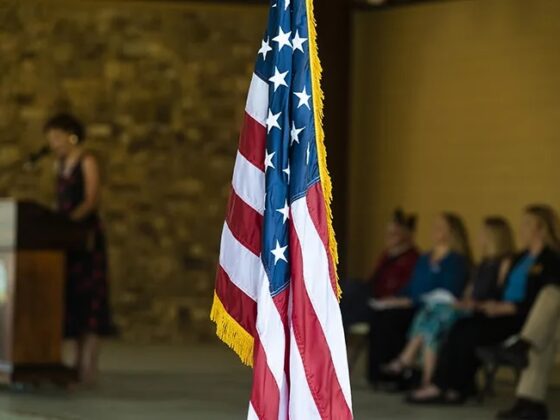
Jack Murphy didn’t mince words when he took the podium at the weekly Norcross PDC meeting on April 29.
“If your engine blows and you’re living on Social Security, what are you going to do?” he asked the crowd gathered at 45 South Cafe, his voice steady but tinged with urgency.
Murphy, executive director of the North Fulton Improvement Council, spent the better part of an hour walking through data, charts and real-world examples of a problem that has quietly taken root in North Fulton: the inability of essential workers — nurses, teachers, firefighters and public safety personnel — to afford living in the communities where they work.
It’s a crisis hiding in plain sight, one that most residents don’t connect to the schools closing, the traffic congestion or the rising property taxes they grumble about over coffee.
The $400 problem
Murphy began with a phrase that stuck with the audience: financially vulnerable. It comes from the Federal Reserve, he explained, and it describes families unable to absorb a $400 emergency expense without calling neighbors or seeking outside help.
“There’s an awful lot of people in that situation,” he said. “A lot of them are our people.”

The mission of the North Fulton Improvement Council is straightforward: build broad public awareness of the challenges faced by these financially vulnerable residents. But the solutions, Murphy suggested, are anything but simple.
He outlined five basic tenets guiding the council’s work, beginning with a behavioral observation that seemed obvious once stated: it’s in everyone’s best interest when people live close to where they work.
Traffic problem nobody’s solving
Murphy gestured to the audience. “How’s traffic here?” he asked, a knowing smile crossing his face. “You’re an island. You’re an oasis in the middle of something. I thought maybe you solved the traffic problem.”
The room chuckled, but Murphy’s point was serious. If North Fulton and surrounding counties don’t create opportunities for essential workers to live nearby, they’ll simply work somewhere else. And that creates a cascade of problems that ripples through the community.
Consider the emergency room director Murphy spoke with years ago. The hospital needed all emergency room staff within a 30-minute radius. “He told me they hadn’t been able to meet that requirement for years,” Murphy said. “What does that mean for you when you go to an emergency room that doesn’t have enough staff?”
It’s the kind of question that should keep residents up at night, but often doesn’t — until it’s their health on the line.
What the numbers tell us
Murphy’s presentation was heavy on data, and for good reason. The numbers paint a stark picture of a region pricing out the very people who keep it running.
In Norcross, Roswell and Alpharetta, for example, housing prices have climbed steadily. Using data and a little help from ChatGPT, Murphy calculated that a family would need approximately $120,000 in annual income to afford the median home price in these communities.
While the median price itself varies — some homes sell below that figure — the overall trajectory is unmistakable: upward and out of reach for teachers earning $45,000 to $90,000 annually.
Murphy shared a personal anecdote that resonated. “I live in a neighborhood, and [today] I could not afford to buy the house I live in,” he said. “It’s a shame.”
He’s not alone. Murphy cited recent data from real estate brokerage Redfin. It found that 30 percent of three-bedroom-plus homes in the United States are occupied by empty nesters who have no plans to leave. They like their churches, their doctors and their friends. So they stay, occupying housing stock that younger families desperately need.
School system connection
One of Murphy’s most compelling slides illustrated a connection many residents miss: the relationship between housing affordability and school enrollment.
Fulton County schools are seeing declining enrollment — a trend reflected across the nation. But when Murphy isolated data from specific North Fulton communities, the picture became clearer. In some areas, student enrollment had declined more than four percent. Meanwhile, in neighborhoods where new housing had been built, enrollment actually increased.

The connection isn’t coincidental. When young families can’t afford to live in North Fulton, they move elsewhere — taking their children with them. Schools close. Property values stagnate. The community ages.
“This should scare us,” Murphy said simply.
Solutions exist — but many are outlawed
Murphy didn’t just present problems. He offered solutions, though he was candid about the obstacles.
Smaller lot sizes, for instance, would allow more housing on available land. Duplexes and “missing middle” housing — triplexes, townhomes, accessory dwelling units — could provide more affordable options while maintaining neighborhood character. Land trusts, where nonprofits own land and sell homes to qualified buyers who build equity, have proven successful in places like Decatur.
But here’s the rub: many of these solutions are currently prohibited in North Fulton communities.
Milton, Murphy noted, has a median lot size of two acres. “You’re not going to get a house for a teacher,” he said flatly. “And that’s a problem.”
The fix, Murphy explained, lies in comprehensive plans. Every five years, cities receiving accreditation from the Georgia Department of Community Affairs must update their land-use plans and zoning ordinances. It’s an opportunity for community input, yet many residents don’t know these plans exist, let alone that they can participate in shaping them.
Reality of commutes
Murphy’s data on commuting patterns also proved eye-opening. Of the thousands of people working in North Fulton, only about 2 percent live and work in the same community. When aggregated across the six cities the council works with, that figure rises to nearly 4 percent.
The implications are staggering. Tens of thousands of people commute into North Fulton daily, clogging roads, straining infrastructure and contributing to the very traffic problems residents complain about.
“Every time I talk to a legislator, they say, ‘Well, you do have workforce housing — it’s in Polk County,'” Murphy said, his tone dripping with skepticism. “That’s a little short-sighted, in my view.”
Harder conversations
During the question-and-answer session, Murphy faced pushback. One audience member accused him of advocating socialism, arguing that young people should simply make “good and tough choices”— delay marriage, postpone children, rent first, then buy.
Murphy didn’t argue. Instead, he refocused the conversation on what residents stood to lose: quality schools, property values, community vitality. He spoke of nurses driving from Stone Mountain because they can’t afford North Fulton. Of teachers contemplating leaving the profession. Of a veteran who’d lived in a Roswell hotel for 11 years.
A 2019 study the council conducted found that one-third of people living in hotels had full-time jobs. Many had children. Some were seniors. They weren’t there by choice; they were there because apartments wouldn’t accept them, and homes were simply unaffordable.
Call to action
As Murphy wrapped up his presentation, he returned to his opening question: Where will your kids live? Where will your grandkids live? Does it matter?
He urged the audience to get involved in their cities’ comprehensive planning processes and to think critically about zoning. He encouraged attendees to consider solutions like duplexes, accessory dwelling units and land trusts — not as threats to neighborhood character, but as ways to preserve community.
“These are decisions that impact you and your kids and grandkids,” Murphy said. “They should be done with some plan.”
It’s a message that extends far beyond that Wednesday meeting in Norcross. As North Fulton and much of metro Atlanta grapples with rising housing costs, declining school enrollment and traffic congestion, the question Murphy posed becomes increasingly urgent: Will this community find room for the people who make it run? Or will it price them out, one $400 emergency at a time?
For more about the North Fulton Improvement Council, visit improvenorthfulton.org.